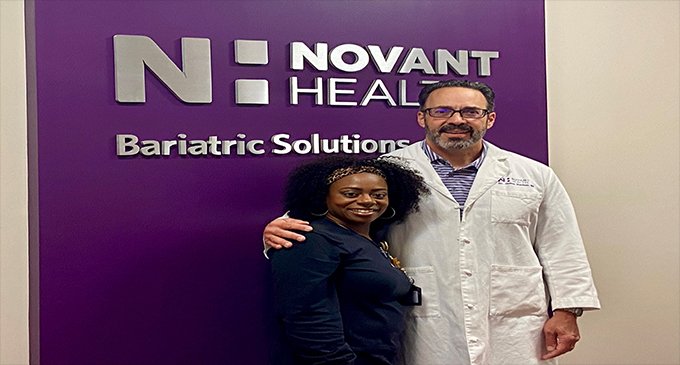
Patients in Dr. James Dasher’s Kernersville office are always inspired when they meet his surgery scheduler, Nakesha Rousseau Freeman. That’s because Rousseau Freeman, 44, does much more than arrange procedures at Novant Health Bariatric Solutions – Kernersville. A former surgical patient herself, she now helps patients prepare, addresses their concerns, and talks them through what to expect.
Through her, patients can glimpse their own healthier future. “This is more than a job to me,” she said. “People who struggle with their weight typically have related health issues. This program allows people to get back to the things they love, to feel better about themselves.”
While dramatic weight loss is a result of bariatric surgery, it’s not why Dasher and his partners perform these surgeries. It’s about overall health, quality of life and longevity.
Bariatric surgery addresses four high-risk health conditions:
*High blood pressure.
*High cholesterol.
*Type 2 diabetes.
*Sleep apnea.
Rousseau Freeman had high cholesterol, but not the other three. However, other conditions improve as a result of this surgery. The risk of breast cancer goes down by as much as 60% to 70%, Dasher said. The risk of osteoarthritis decreases, too. Because the treatment plan focuses on health more than weight loss, the multidisciplinary team is composed of all the providers a patient needs to be successful – dietitians, nurses, nutritionists, behavioral health professionals.
Rousseau Freeman’s weight wasn’t always an issue. “Growing up, I was tiny,” she said. “I was a dancer and a high school cheerleader. When I got older and put on weight, I felt like I was in someone else’s body. I really started feeling that way after the birth of my second child. I started looking at myself and thinking: ‘What am I going to do?’” At her heaviest, she was between 190 and 200 – a lot for her 4’10” frame. She tried many diets, and they’d work for a while but not for the long term.
In addition to putting on weight, Rousseau Freeman had begun experiencing painful symptoms of gastroesophageal reflux disease (GERD) while pregnant with her first child in 2005. Over-the-counter medication didn’t help, and her symptoms persisted after her second baby was born. “The heavier I was, the worse the GERD became,” she said. “It was frustrating and scary. It would hit in the middle of the night, and I’d jump up and vomit. I’d get heartburn from just drinking water.”
In 2021, while working on the mother-baby unit at Novant Health Forsyth Medical Center, she kept hearing about Novant Health’s nearby bariatrics center. Rousseau Freeman registered for a surgical seminar held over Zoom. That led her to make an appointment with Dasher, who asked why she wanted surgery. Her answer: To get healthy.
She understood the work involved on her part – and she was ready. “I tell people all the time: This is not the easy way out,” she said. She also stresses to patients: “Your mental attitude about food and overall eating has to change in order for this tool to be successful.”
Dasher recommended sleeve gastric bypass, also known as one anastomosis gastric bypass (OAGB), because it’s effective for weight loss as well as for lowering the risk of heartburn and reflux. Plus, it would likely improve or eliminate her GERD and allow her to come off all her medications.
Not every patient is a good candidate for bariatric surgery. But Rousseau Freeman was. There are two reasons for that, Dasher said. “First, she was a good candidate from an insurance perspective. Insurance companies want to see a BMI of 40 or higher to cover bariatric surgery. If you have a lower BMI – in the 35 to 40 range – but have chronic conditions, such as diabetes and high blood pressure, you can still be a candidate in the eyes of most insurance plans.
“If your BMI is over 40, that’s what we call ‘morbid obesity,’” he continued. “That word – morbid – has a scary connotation, but I think it’s accurate. Morbid obesity can take seven to 10 years off your life expectancy.”
The second reason Rousseau Freeman was a good candidate: “Her willingness to make major lifestyle changes and to do it for the right reasons,” Dasher said. “It’s not about being skinny. It’s about getting healthy and living longer.”
Patients have to make lifestyle changes before and after surgery. The pre-op process involves an all-liquid diet in the weeks leading up to surgery and again after surgery.
Rousseau Freeman had surgery in July 2021 at Novant Health Kernersville Medical Center. “When I woke up, I didn’t feel hungry,” she said. “And that was crazy because the day before, you can only drink liquids. It was like a weight had been lifted.”
Still, she knew she had a lifetime of work ahead of her.
It’s a message Dasher and the team reiterate. “I tell patients that if they follow our instructions for five years post-op, then they’ll have good results for five years,” Dasher said. “If they stop making healthy choices and stop exercising, they can’t expect the same results.
“When bariatric surgery was new, many surgeons would operate, see the patient for a follow-up and wish them luck. We’ve done things differently at our practice. We see patients a week after surgery and again at the two-month, six-month and one-year mark. We do labs at the six-month and one-year mark. We want to see patients once a year forever. We feel like, since we’re asking patients to make a lasting change to their lifestyle, we had better be available to them for a lifetime, too.
“The support available before and immediately after surgery is there for a lifetime.”
Bariatric surgery is often life changing. Little by little, patients reclaim their lives. For Rousseau Freeman, that meant taking up dancing again. “I used to love to dance,” she said. “But when I got bigger, I’d get tired too fast. Now I turn the music on blast at home and feel I can dance forever.”
A year after surgery, Rousseau Freeman applied to be an insurance specialist in Dasher’s office. But Dasher had another job in mind for her. He thought she’d be even more valuable as a surgery scheduler. She’s also a role model, support system, cheerleader and sounding board for her patients.
“Nakesha is empathetic, since she’s been down this path herself,” Dasher said. “Just by sharing her story, she’s an inspiration to our patients. She’s proof that you can become healthier when you trust the program and do the work along with our team.”
It’s meaningful work – a calling, in fact. “I feel I’m making a difference because I’m part of someone’s journey to stay around for their kids and grandkids,” Rousseau Freeman said. “That’s why I’m here.”
For the latest in news and advice from Novant Health, visit www.healthyheadlines.org
Page Leggett is a freelance writer and storyteller whose work has also been published by The Charlotte Observer, Business North Carolina and SouthPark Magazine, with a focus on healthcare and the arts.