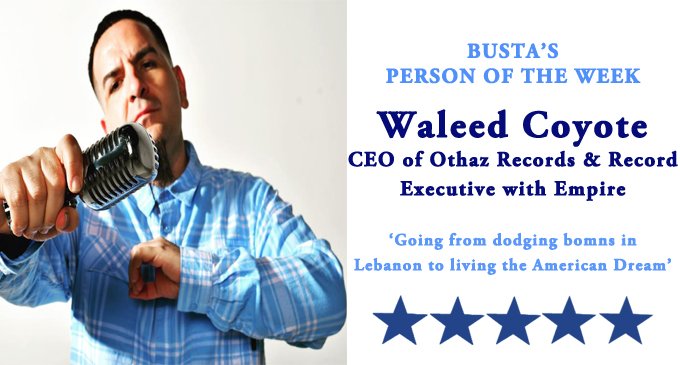
By Busta Brown
“In 1976 I was born in Brighton, England, because they were bombing the hospitals in Lebanon. We eventually moved back to Lebanon. In 1982, I was only six years old when Israel invaded Lebanon. My pops said, ‘Today I’m going to make you a man.’ We went across the street to pick up my mom, and I remember seeing bodies, bombs, and guns. It was wild, Busta. I saw soldiers everywhere. I still remember the sounds of the bombs as if it were yesterday,” shared Waleed Coyote.
I was very impressed with how calm and collected he remained as he shared his amazing, yet traumatic, journey to the United States. In 1984 a bomb landed on top of the building where he and his family lived, but fortunately it was a dud. “That’s when my pops said, ‘That’s it. We outta here!’”
He and his family moved to Greensboro in 1984, where he attended Ben L. Smith High School and then went on to graduate from Western Carolina University. After college, Waleed was on a serious mission to live his childhood dream of becoming a radio personality and mover and shaker in the music industry. He credits his father for teaching him the value of hard work. “He never referred to me as a boy when I was growing up. He always referred to me as a man, so watching my parents lose their entire fortune taught me how to appreciate life, money, and opportunity.
“The reason foreigners are successful when they come to the United States is they’re able to get here and then maximize what they have. I don’t take holidays off. Most Americans feel they’re entitled to it. My parents taught me that you could lose it all, at any time, with no fault of your own. So, I’d rather work hard to make sure I’m always prepared. The government can shut down at any time; then what? This thing can be over, so I’m always on the grind. I’ve learned to take advantage of the opportunities America has to offer.”
Waleed’s family also took advantage of the opportunities this great country has to offer. His brother is a successful surgeon in New Jersey, and his cousin, Ghazi Shami, is the CEO and founder of Empire, a successful distribution, record and publishing company in San Francisco.
Hip-hop artist Luke Nasty told a San Francisco newspaper that he saw Ghazi come up from nothing. From three people in one room with two computers, to on the top floor of one of the tallest buildings in San Francisco. Luke has two gold records with Empire. Waleed Coyote is Luke Nasty’s manager and is responsible for introducing him to Empire.
Now, let me take you on Waleed’s journey to becoming a top record executive with Empire record company and a club owner.
Before Waleed took over as Luke Nasty’s manager, he was living his childhood dream as one of the top radio personalities in the Triad on 102 Jamz and a successful club owner and promoter. Coyote got the radio itch when he was a kid. “When I first heard NWA, I was in the 6th grade; it blew me away. I didn’t want to do anything else but listen to rap music, so being on the radio became my dream. I listened to you growing up, Busta. You were one of my main heroes. The crazy interviews and beef you had with people like Puffy and Jay Z. You had Puffy send his people after you, bro,” said Waleed as we laughed out loud.
I remember those days very well! The months after I interviewed Puffy turned out to be one of the most frightening moments in my life. (But that’s for another day.) Waleed continued, “You were wild, Busta B, and I said, I want to be like that.”
After graduating from college, Waleed hustled hard and eventually landed an internship at 102 Jamz. “I wanted to change the culture of hip-hop, but I had limited resources, so I saw radio as a way to make it happen.” Waleed put in the hard work and dedication that his father instilled in him. The results paid off big time. It wasn’t long before he had the number one radio show in the country from 7 p.m. until midnight.
His journey wasn’t smooth sailing by any means. He had a huge mountain to climb. “I always had to over-prove myself. People would say I was trying to be Black. I just wanted to be me, but I loved and respected the culture,” said Waleed.
The greatest challenge for Waleed was the acceptance of the radio station’s audience and clients. During his first club appearance, he came face to face with that challenge. The experience broke his spirits and nearly turned deadly. “I was at a club in Roxboro, North Carolina. When I walked into the club and introduced myself to the owner, he said, you’re not Waleed. I said, yes, I am. He said, no you’re not and I’m not paying you. Waleed is a Black dude. My audience assumed I was Black until they met me. So, he pulled out his gun. He said, show me proof. I was like, I’m about to die tonight in Roxboro. I showed him my ID, and then I rocked that club so hard that night. He said, you’re going to be my DJ forever, bro. It’s always been a challenge for me because the crowd or promoters didn’t believe I could rock a Black crowd.”
He quickly became the most sought-after club and concert MC in radio. In 2001, Waleed and legendary hip-hop producer DJ Khaled were the only Middle Eastern radio personalities in America. “I’ll never forget that day, September 11, 2001. It was crazy, Busta!”
Waleed’s popularity landed him one of radio’s prime time slots. 3p-7p. “That was my dream shift. I was going to be big like Busta Brown! But by then radio had changed and it wasn’t fun anymore. I couldn’t do all of the features that made me number one from 7p-midnight. 102 Jamz was the only radio station I wanted to work at, so it was tough. But I learned my worth, and I realized I needed to do radio on my own terms. Guys like Dana Lucci and Will Ski were doing it big in the music game, so I knew something more was in the cards for me as well. I also felt as if the station thought I was about to age out, and I didn’t want an expiration date on me like milk. I wasn’t expiring.”
The journey begins!
Waleed’s cousin Ghazi asked him to move to San Francisco to run Empire’s radio department. He took a leap of faith and moved. “I had a club and I started my own record label, Othaz Records. I signed some of the hottest local artists and I had one of the hottest clubs in the Triad. I had everything I ever wanted. But I couldn’t break these records. I needed to take my record label to the next level. So, I moved to San Francisco.”
All Waleed took with him was his faith and a vision. “I had nothing when I moved.” Later, Waleed took his artist Luke Nasty with him and Empire got behind Luke’s song, ‘Got To Be.’ “That record changed my life! The first assignment I had was to make that record a hit, and it became the number one record in the country. I left radio in September 2015 and here I am in January 2016 on tour with Luke. It all happened that fast!” boasted Waleed. He’s a great example that faith, hard work and dedication does pay off.
The CEO and record executive has worked with some of the biggest names in the music and entertainment industry, and is well respected by his industry peers. And he’s just getting started. But, like radio, there’s the good, the bad and the ugly in the music biz as well. “The ugly is when the artist believes they are bigger than they are. One hit record can create seven different streams of income. That’s why today’s artists make so much money. Between royalties and appearances, there’s a lot of young multi-millionaires in the music game. When these young artists see those big numbers on TikTok, YouTube, radio and other music platforms, they forget about the hard work it takes to stay on top. A lot of artists don’t understand the business and how the revenue works, and can lose it all,” shared Waleed.
Hip-hop is the number one genre in the music industry, surpassing rock, pop, and country music. The best example is this past Super Bowl halftime show featuring Dr. Dre, Snoop Dog, and Kendrick Lamar, hip-hop and R&B queen Mary J. Blige, and Eminem. Some argued it was the best ever. I do agree it was a great performance, but strongly disagree it was the best ever. It’s not even in my top 10 halftime shows of all time.
I asked the music mogul why ‘90s R&B artists such as Jodeci, 112, Jagged Edge, Boyz 2 Men, Brandy, Monica, Faith Evans, and others couldn’t survive the hip-hop era. “The spending power of the hip-hop generation played a huge role. And when rappers started singing, it was a wrap. That turned R&B into hip-hop, but I’m sure R&B will make a comeback.”
What’s the next phase in music? “The scariest thing in the world is A.I. Artificial intelligence has the ability to make music. Real robots will eventually make music. They will figure out our algorithms of what we personally like and begin to create music based on that. I believe songs will get shorter as well. The robots will only make songs with the hooks, or chorus. I call it TikTok music, a three-second record that will get looped over and over. Because of COVID, young people are used to staying home and entertaining themselves. They’re not going to sports events, clubs, or concerts. So, we have to make music for them. In their mind, people are scary, but in our minds, we’re trying to put thousands of people in a building. So that’s where music is going. We have to make music for the Metaverse generation.”
So, what’s in the future for Othaz Records and his other businesses? “I’m going to put studios in the schools to teach students how to capitalize on how to produce music for their generation. I want to show youth that they can be successful without drug dealing, gang banging, or any illegal or criminal activities. I’m going to do my part to build North Carolina above and beyond, and our mission won’t be complete until we put North Carlina where it belongs, and empower the people. And we’re going to continue producing more platinum and gold records.”
My phenomenal Person of the Week is Waleed Coyote.