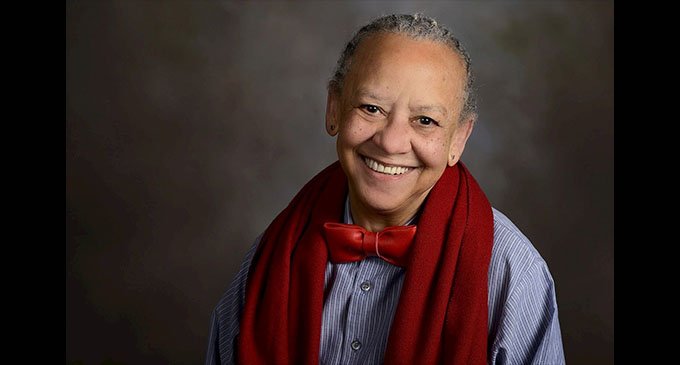
By Felecia Piggott-Long, PhD
Born Yolande Cornelia Giovanni Jr. on June 7, 1943, in Knoxville, Tennessee, to Jones and Yolande Giovanni, Nikki Giovanni became one of the most audacious young poets to emerge from the Black Arts Movement of the late 1960s and early 1970s.
While reading the poetry of Nikki Giovanni, I became an activist, a militant soul in search of a revolution. The first books that I purchased from her collection were “Black Feeling, Black Talk” (1968) and “Black Judgement” (1969). The most recent purchase I have made from her collection is a children’s book called “I Am Loved” (2018). My favorite two poems that she wrote are “Ego-Tripping” and “Nikki-Rosa.” I was also intrigued when I read “The True Import of Present Dialogue, Black vs Negro.”
I fell in love with poetry as a powerful form of rhetoric when I read “Ego-Tripping” because she used allusions to African history and culture as well as biblical imagery. Her diction exudes so much confidence for a young, African American woman in a world determined to keep her from finding her voice. Also, I enjoyed “Nikki Rosa” because the speaker comes to the epiphany that she does not have to struggle with the notion of “double-consciousness” that Dr. W. E. B. DuBois espouses in “The Souls of Black Folk” (1903).
As a freshman in college, I was intrigued that a young Black female would ask the question, “Nigger, can you kill?” This line smacks of the violence generated from the conflicts of the 1960s and 1970s, but the question is still being examined today in gangs and homicides and other forms of violence. I have used all of these poems in my presentation called “History Through the Eyes of the African American Poet.” I have presented this chronological poetry recitation in churches, schools, at community events, at the Governor’s School, at such as Kwanzaa or Juneteenth, and even during Maafa.
I love the children’s book “I am Loved” (2018) by Nikki Giovanni. The poem “I am a Mirror” states “I reflect the grace / Of my mother / The tenacity / Of my grandmother / The patienc / Of my grandfather / The sweat / Of my great-grandmother / The hope / Of my great-grandfather / The songs / Of my ancestors / The prayers / Of those on the auction block / The bravery / Of those in the middle passage / I reflect the strengths / Of my people / And for that alone / I am loved.”
Giovanni was so daring. As Ralph Waldo Emerson stated in his essay “Self-Reliance,” “To be great is to be misunderstood.” At the end of her life, thousands have discovered Nikki Giovanni’s greatness.
I recently spoke with one of my professors, Dr. Trudier Harris, University of North Carolina-Chapel Hill, who attended Giovanni’s funeral service on Sunday, Dec. 15, at McCoy Funeral Home in Blacksburg, Virginia. The funeral was small and private – by invitation only. In fact, guests’ names were checked off as they entered the chapel of the funeral home. The audience of 150 people included the young, elderly, Black and white. Of course, photos were not allowed. At this first gathering, “scholars, professors, poets, writers, friends, former students, colleagues – a few famous, others just regular folks” = showed up,” said Dr. Harris.
This is not the final hour, for Nikki Giovanni will be buried in another private ceremony in Cincinnati, Ohio, on Thursday, Dec. 19. There will be a public memorial service, where thousands could attend, that will take place in Blacksburg on Feb. 16, 2025.
Whenever I want to show my students the power of poetry, I use the work of Nikki Giovanni, and the children are inspired, males and females alike. Nikki Giovanni was a part of the Black Arts Movement and it will never die. She is now an ancestor, seated among the conduits of our people.
Sankofa! Ashey!